A hydraulic hammer can tell an operator when something is wrong. It may start leaking. It may not hit as hard as it used to. Eventually, it may stop working altogether. What it cannot tell the operator is why. Finding that answer means going inside the hammer, sometimes piece by piece.
Milton CAT provides on-site, all-make hydraulic hammer maintenance and repair services at its service shop locations in Milford, Massachusetts, and Batavia, New York. Whether the hammer carries a CAT decal or another manufacturer's nameplate, the repair process begins before the first bolt is removed: understanding what the customer was experiencing in the field and what brought the hammer into the shop. Customers located throughout Milton CAT's territory can take advantage of the company's daily shuttle network, which helps smaller hammers reach either repair facility as soon as the next business day.
"There are a bunch of different complaints it could be in for," said Chris Bailey, Milford’s Hammer and Specialty Shop Supervisor. "It could have a leak, could not be operating, so we need to get information from the customer to see what's happening."
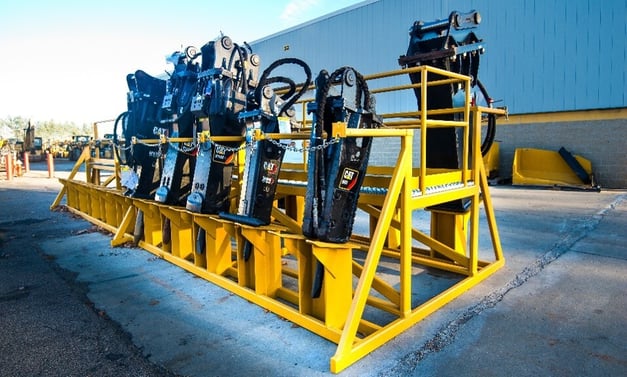
CAT hydraulic hammers of different seizes at Milton CAT’s Milford Facility.
What You Cannot See from the Outside
When the hammer enters the shop, it gets a preliminary cleaning in the steam bay to prevent dirt and grime from entering the components during disassembly. Fluids are drained, hydraulic hoses and external accessories are removed, and the hammer is placed on a bench for teardown. Depending on its size, completely disassembling a hammer can take anywhere from half a day to two days.
But taking it apart is only the beginning.
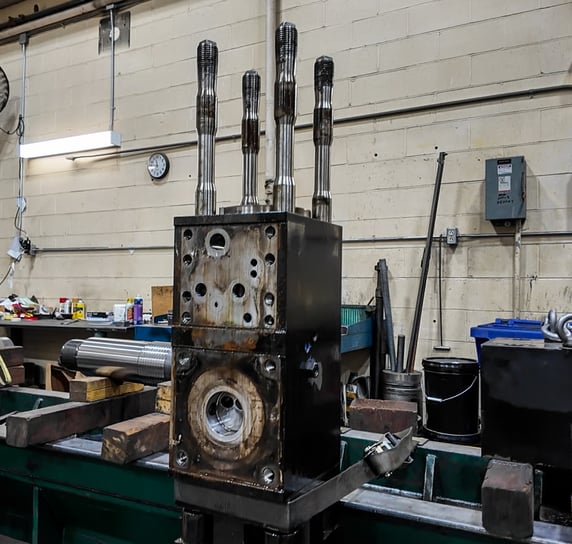
A hydraulic hammer is disassembled for inspection, giving technicians access to the internal components that will be evaluated during the rebuild.
Once the hammer is open, technicians can begin looking for the story its exterior could not tell. A hammer that has been worked hard for long periods, for example, can show signs of excessive heat internally. Bailey explained that hammers are designed to operate in approximately 15-second bursts, with short breaks in between. Running continuously for too long can generate heat, causing metal components inside the hammer to expand and potentially suffer damage.
One place technicians may see evidence of that is on the piston, the component that fires downward, strikes the tool bit, and ultimately transfers the hammer's force into the material being broken.
"If a hammer has been used too long in one spot without that relief off the button, we'll see scoring or even bluing from temperature, from high heat on that piece," Bailey explained.
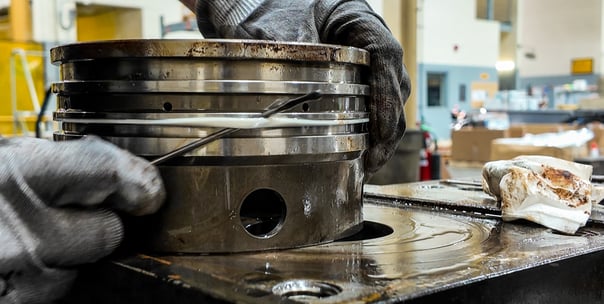
During disassembly, internal components are carefully inspected as technicians look for wear and other conditions that could affect hammer performance.
Finding damage, however, does not necessarily mean immediately replacing the component.
Depending on its condition, a damaged piston can often be resurfaced on a lathe.
Technicians can remove a few thousandths of an inch of material to restore the surface, but there is little room for error. Bailey said technicians typically have only seven to ten thousandths of an inch of allowable material removal before the piston falls outside acceptable tolerances. In many cases, that means a piston can be resurfaced once. If similar damage occurs again, replacement may be necessary.
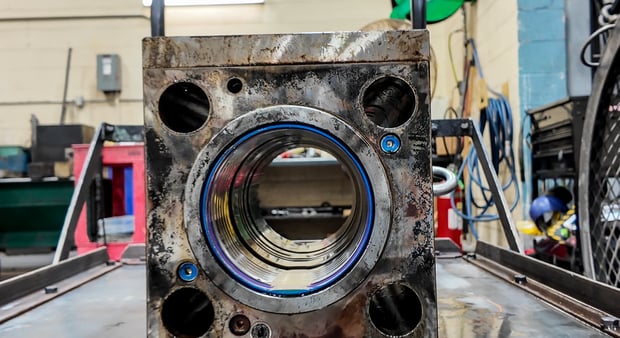
New sealing components are installed inside the hydraulic hammer as it is prepared for reassembly.
The same attention is given to the cylinder through which the piston travels. Rather than looking only at the dimensions of the individual components, technicians also have to consider the running clearance between them. Too much clearance and the seals will no longer perform as intended. It is measured in thousandths of an inch and decisions that cannot be made simply by looking at a part.
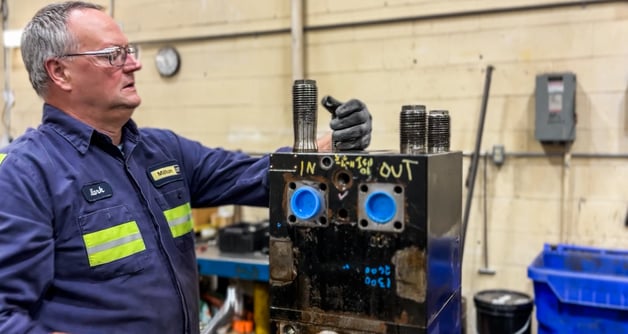
A Milton CAT technician prepares a hydraulic hammer for removal of its internal components during disassembly.
"Looks All Right" Isn't the Standard
Once a hammer has been completely disassembled, every individual component is cleaned, inspected, and measured to determine whether it can safely be reused.
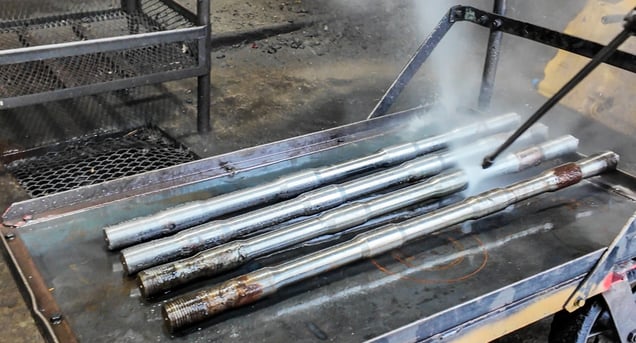
Internal hydraulic hammer components are thoroughly cleaned before inspection and reassembly.
For CAT hammers, technicians use Cat reusability guidelines and specifications to make those decisions. When a non-CAT hammer comes into the shop, Milton CAT can reach out to the manufacturer to obtain available technical information.
Bailey describes the philosophy simply: follow the specifications and do not skip steps.
"We follow it by the book, make sure we don't overlook anything," he said. "Never, 'That looks all right.' We make sure we take the time to measure it, inspect it, make sure it is, in fact, good to be reused."
That distinction matters because something overlooked during a rebuild may not reveal itself until the hammer is back on a customer's machine and back on the jobsite.
"The biggest one is customer downtime," Bailey said. "If something's overlooked, we put it back together and the customer gets it back and it still does not work. Doesn't look good for us. Customers have more downtime and they're not happy."
Showing the Customer What Was Found
Inspection is also about giving the customer information before the repair moves forward. After disassembly and inspection, the technician identifies the parts needed for the repair and adds them to the work order. The findings are reviewed and a quote is prepared.
Customers bringing in hammers also receive an inspection report documenting the shop's findings, including photographs, measurements, and any identified damage.
"That helps customers see exactly what we're finding and what they're spending their money on," Bailey said.
The customer can then decide whether to proceed with the recommended repairs. Occasionally, customers choose to reuse a component even when the shop recommends replacement. Milton CAT leaves that decision to the customer but makes the consequences clear. A component reused against the shop's recommendation will not carry the same warranty protection if it subsequently fails.
The objective is not to replace parts unnecessarily. It is to make an informed decision about what can reliably go back into service.
For customers, that process helps ensure repairs move forward efficiently and that the hammer returns to service as expected. Paul Crosby of Cold River Materials in Walpole, New Hampshire, recently brought a CAT H140 hammer to Milton CAT for repair.
Asked why he chose Milton CAT for the repair, Crosby pointed to both the Caterpillar product line and the shop's performance.
"We chose Milton CAT because it was a Caterpillar hammer," he said. "We had a good experience. They did the repair when they said they would."
Putting It Back Together
Once the repair is approved and the required parts arrive, reassembly begins.
Having access to parts is often a key factor in keeping repairs on schedule. Reflecting on his experience, Crosby said one of the things that stood out to him was that the necessary parts were available when needed.
"They had the parts available and kept the repair on schedule," he said.
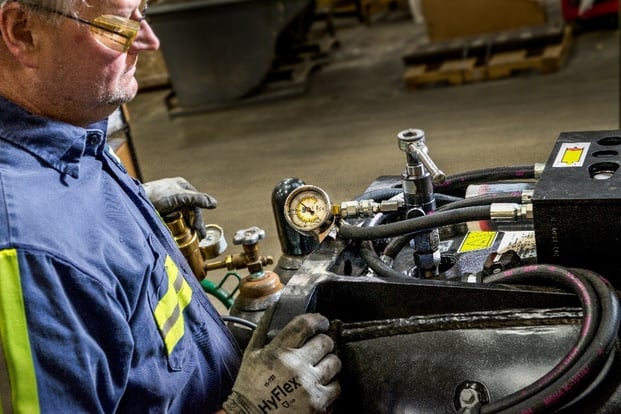
After reassembly, technicians check the hydraulic hammer to verify proper operation before it is returned to service
The lower, middle, and upper sections of the hammer are resealed and stacked together. Long tie rods secure the power cell assembly, and their large nuts require considerable torque. For that work, technicians use air-powered torque multipliers capable of delivering the torque required for the fasteners.
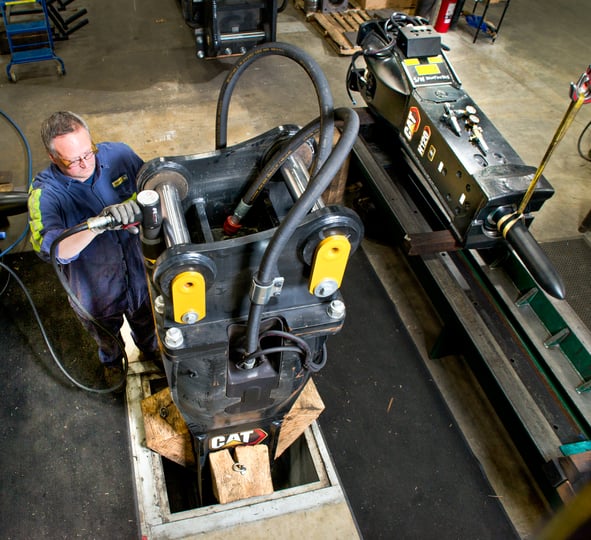
Both the Milford and Batavia repair shops have recessed pits that allow technicians to lower tall hammers below floor level during portions of the reassembly process. Instead of working from ladders or above their heads, technicians can position the hammer at a more practical working height while installing the power cell into its housing. External accessories, rubber components, and hydraulic hoses are then reinstalled before the upper bracket completes the assembly.
Hydraulic hammer repair is specialized work, requiring technicians to combine hydraulic expertise with the experience needed to recognize wear, interpret measurements, and follow the specifications that determine whether individual components can be returned to service.
Getting It Right the First Time
For the contractor waiting for a hammer to return, the internal measurements, clearances, and assembly procedures may never be visible.
The downtime is.
For contractors, minimizing that downtime is often the most important measure of a successful repair. Asked how important it is to have a hammer repaired correctly and returned to service quickly, Crosby's answer was brief:
"Very important."
That is why the objective of the repair goes beyond getting the hammer back together.
"We don't want to overlook anything. We don't want the customer to be stuck," Bailey said. "We don't want them to wait two weeks to get their hammer back. They hook it up to the machine and it does the same thing it did before or it doesn't work."
Milton CAT backs its service work with a warranty, and parts used in the repair carry a one-year warranty.
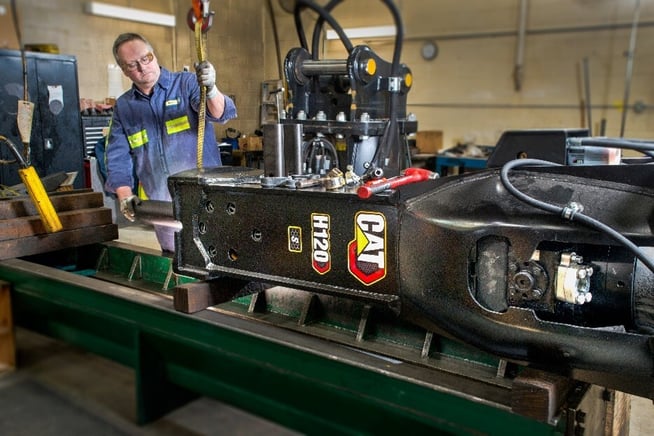
A CAT H120 Hydraulic Hammer moves through the service process at Milton CAT’s Milford shop.
Asked what a contractor gets by bringing a failed hammer to Milton CAT rather than another repair shop, Bailey came back to the combination of resources and experience behind the repair.
"We have the right tools, the right parts, and the experience," Bailey said. "We have access to everything needed to fix it right the first time."
Based on the experience, Crosby said he would not hesitate to bring another hammer back to Milton CAT for repair.
"They had the parts and completed the repair on time," he said. "I would definitely bring another hammer back."
Because when a hydraulic hammer stops working, repairing what is visible is only part of the job.
The real work is finding what isn't.