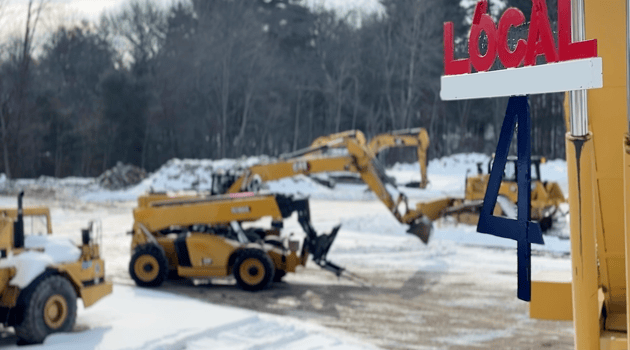
On weeknights and Saturdays in Canton, MA, apprentices and journey members gather at the International Union of Operating Engineers Local 4 Training Center to learn what today’s job sites demand. Inside the classroom, digital terrain models glow on screens. Outside, machines are equipped with the Trimble GPS technology supplied and supported by SITECH Northeast. These are the very same type of machines that are used on active construction projects across New England. This is not abstract training. It’s preparation for real work.
At a time when construction is becoming increasingly data-driven, Local 4 has reshaped how it trains operating engineers, combining traditional skills with Trimble GPS technology to ensure members arrive on job sites ready from day one. “You have to know how to run a bulldozer first,” says Ron Champagne, one of the program’s lead technology instructors. “Then you can apply this new technology to make your life easier.”
A Training Program Built for Reality
Local 4’s approach is deliberate and comprehensive. According to Peter Carpenter, instructor at Local 4, what sets the program apart is not just the equipment, but the people delivering the instruction. “The people make the training program unique,” Carpenter explains. “The professionals who work for some of the largest signatory contractors in New England come down here part time, and their experience and skill level is what allows us to train future operating engineers.”
The structure follows a clear progression: classroom instruction, simulation, and hands-on field work, what Carpenter describes as “crawl, walk, run.”
For apprentices, that structure removes much of the intimidation around new technology. “It maybe took ten minutes for me to get a rundown of how to use it,” apprentice Victoria Johnston says. “From there, I was ready to go.”
The apprentices featured in this training are not beginners stepping into a machine for the first time. They are fourth-year students who are already working full-time for signatory contractors. Classes take place in the evenings and on Saturdays to accommodate full-time work schedules, allowing apprentices to deepen their technical skills while remaining active on jobsites. While some employers encourage participation, apprentices themselves are often motivated to expand their capabilities, knowing that today’s job sites expect operators to arrive with both hands-on experience and fluency in modern technology.
“It’s a unique opportunity down here that is not duplicated anywhere else that I know of,” Peter Carpenter adds.
From Machines to Connected Construction
Across the construction industry, technology is reshaping how projects are planned, built, and delivered. Brian Riley of SITECH Northeast explains that Trimble’s role in construction has evolved far beyond machine control. “Trimble doesn’t want to be just a GPS company or a machine-control company,” Riley says. “They want to become the central brain of the entire construction process, from the very first idea of a project to the final completion and documentation.”
Design, estimating, construction, verification, and reporting are now connected through shared data, utilizing Trimble Works Manager software. Operators are no longer isolated in the cab, they are participants in an end-to-end workflow. “That means when technology comes out, we need to make sure we understand it first before we send it out to customers,” Riley explains. “That’s a huge part of why we’ve been successful.”
Local 4 has embraced that shift, ensuring its members understand not only how to follow grade, but how their work fits into the broader life of a project.
For apprentices, that connection shows up in simple, practical ways. “Having GPS on the machine definitely helps because you can see everything that’s going on,” apprentice Colin Wright says “It takes the guesswork out.”
Teaching What Contractors Expect
For instructors like Ron Champagne, the motivation behind the training is straightforward. “Contractors are not going to pay someone to teach other operators anymore,” he says. “They expect you to know this.”
That reality is why Local 4 invested in permanent technology infrastructure at its Canton campus, classroom emulator-based learning, a Trimble base stations, and machines equipped with Trimble Earthworks technology, so learning happens before apprentices ever step onto a live job site. “The goal of the training program is to impart the best knowledge we can, with the best technologies we can, with Trimble, through Milton CAT,” Ron Champagne says.
The impact is immediate. Apprentices don’t just react to the machine, they understand it. “I definitely feel much more confident in the cab with the GPS,” apprentice Justin Pothier notes.
When Experience Meets Technology
Not everyone initially trusted GPS. Instructor Scott Snow remembers his own skepticism. “My first impression was, they’re trying to take my job away,” he says. “But the more I used it, the more I started liking it.”
Instead of replacing experience, technology reinforced it. “You don’t have to worry about knocking over stakes,” Scott Snow explains. “And everything feeds back to the office. You don’t have to prove what you did, it’s already recorded.”
For operators in the field, respecting experience while embracing innovation is what gives the training its credibility. That balance is reinforced by hands-on instruction. “The thing that helped me understand it better were definitely the instructors,” Colin Wright says. “Hands-on training is the way that I learned best.”
Proof in the Apprentices
The clearest validation of the training comes from the apprentices themselves. “This training does make me a competitive operator alongside the more senior operators out there,” Justin Pothier says. “This gives me a chance.”
Others point to efficiency and readiness. “Having GPS makes me work a lot more efficiently, a lot faster,” Victoria Johnston explains.
And many recognize what this means for their future in the industry. “This technology is the future,” adds Victoria Johnston. “You’re going to see it on the job site, so knowing this technology is going to give you a competitive edge.”
Partnership and Proximity
Supporting this level of training requires more than technology, it requires partnership. As Brian Riley explains “The relationship between SITECH Northeast, Local 4, and Milton CAT is unique in our Industry.” “The partnership is built on the desire to have the next generation of skilled operating engineers train on Trimble Machine Control Technology. SITECH Northeast is proud to be a small part of Local 4’s 129 year tradition of offering education to the local workforce.”
Local 4 works closely with Milton CAT and SITECH to ensure apprentices train on the same CAT and Trimble systems used across the region’s job sites. According to Peter Carpenter, proximity plays a critical role.
“The Milton CAT facility in Stoughton is about ten minutes away and has been a huge benefit to the training center,” he says. “Especially on Saturdays, our heavy training day.”
That closeness means faster support, shared expertise, and alignment between training and real-world conditions. “Having the Trimble technology here makes operating engineers more valuable to contractors,” Peter Carpenter adds. “It makes them more efficient and more productive.”
Preparing for What’s Next
As technology continues to evolve, the training evolves with it. “When you think you’ve learned everything,” Ron Champagne says, “something new is already coming.”
What remains constant is the goal: preparing operators who understand their craft, their machines, and the systems that connect modern construction. “With Trimble and Milton CAT,” Champagne says, “you’re working at the highest level, they are the best partners in the industry.”
For Local 4, that partnership helps ensure its members are ready, not just for today’s job sites, but for the future of the trade itself.
Watch the video below!