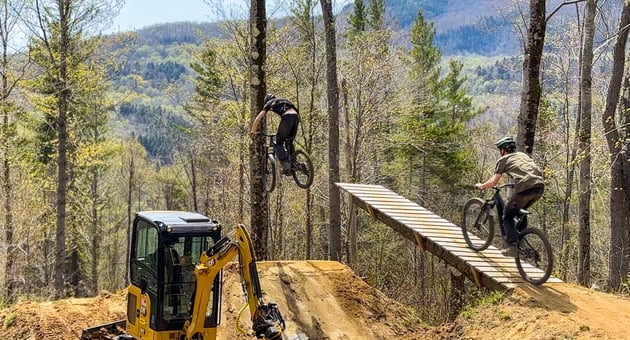
Deep in the woods, on a rugged mountainside in Bolton, Vermont, compact excavators move carefully through steep terrain, shaping trails that will eventually disappear into the landscape as if they had always been there. It’s a demanding highly specialized work, part excavation, part design, part riding knowledge, carried out far from paved roads, cell service, and easy conditions.
For Tom Lepesqueur, founder of Lepesqueur & Daughters, LLC, that also goes by L&D Trailworks, the path into trail building was far from conventional. While studying neuroscience in college and considering more school, he found himself increasingly drawn toward mountain biking and trail work, a passion that slowly became a profession. “Throughout college, I had some ideas that would have involved me going to more school,” said Tom Lepesqueur.
“But I think the passion for bike riding and trail building sort of took hold at some point, and then I never really escaped its grasp. And that just sort of slowly evolved into this, being what I do”, declared Tom. Today, Tom Lepesqueur and his 4 members crew build a few different kinds of trails, though, most of their work focuses on mountain bike trails systems.
What sounds straightforward from a distance quickly reveals itself to be far more specialized. Trail building, he explains, is not simply “digging dirt.” It requires understanding how riders move through terrain, how water travels through the landscape, how trails evolve over time, and how every turn, berm, and transition affects the overall experience. “It takes some level of expertise to understand how a trail is going to flow, how it’s going to ride, how sustainable it will be over time,” he explained.
That understanding comes not only from operating equipment, but from riding trails firsthand. “You really have to understand how a bike flows through a trail,” Lepesqueur explained. “How one thing you build will affect the next thing that is going to happen sequentially as you ride through a trail.”
Today, Lepesqueur & Daughters operates in some of the most demanding environments in New England, where long days, changing weather, and remote terrain are simply part of nearly every workday. “It’s 100 degrees, the bugs are out, or it’s pouring rain, or it’s freezing cold, and you're getting snowed on,” Lepesqueur said. “The trail building project could be remote. It can be hard to get to. Things break out in the woods. Stuff happens. It's just not an easy job.” Then, with a slight smile, he added: “Mother Nature always wins.”
Because of the terrain and the narrow profile required for mountain bike trails, Lepesqueur & Daughters relies heavily on compact equipment, like the CAT 302 and CAT 303.5E mini excavators. “We use very small excavators out here,” Lepesqueur said. “We’re trying to keep things as confined to the area we’re working in as possible.”
For his team, compact size alone is not enough. Reliability and support become critical when working remotely with a short construction season. “The reason we are using the CAT 302 in particular is because it’s got the best blend of functionality and creature comforts,” he said.
“You’ve got the narrow retractable tracks… which is pretty ideal for building close to single-track style trail, but at the same time we have a closed cab, air conditioning, and a lot of nice features that make running attachments pretty seamless. And they’re really reliable.”
That reliability extends beyond the machine itself. “My relationship with Milton CAT goes back way before starting this business in Vermont,” Lepesqueur said. “It was always really easy to get help, to get parts.”
For crews working in remote terrain, fast support can make the difference between staying productive and losing valuable days during New England’s already limited building season. “When something does break, because everything breaks, we can get that help. We can get those parts,” he said. “The equipment’s good, the service is good, the communication is good. It’s just been a long, easy relationship.”
One of Lepesqueur & Daughters’s most unique recent projects has focused on adaptive trail design, creating trails accessible to athletes using three- or four-wheel adaptive mountain bikes.
At Bolton’s Driving Range trail network, Lepesqueur and his crew helped build what he describes as a “double black diamond adaptive optimized trail,” a rare and highly technical accomplishment. “These trails are rideable for athletes with disabilities,” he explained. “There are a lot of constraints and considerations, but there are also more opportunities than people would guess.”
Watching adaptive riders successfully navigate advanced terrain has become one of the most rewarding aspects of the work. “Watching an adaptive rider ride maybe an advanced feature here who maybe couldn't always access something like that in a typical network is one of the best feelings,” Lepesqueur said.
While trail building remains a niche profession, the industry has seen significant growth in recent years as outdoor recreation and mountain biking continue to expand across New England. In Vermont, initiatives such as the Velomont Trail project, an effort to connect trail networks from Massachusetts to Canada, are helping drive new trail development through partnerships between local organizations and federal land managers. For builders like Lepesqueur and his crew, that growth means more opportunities to create trails that are not only sustainable and technically challenging, but increasingly accessible to a wider range of riders.
For Lepesqueur, however, success is still measured in simple terms. “When a trail is completed,” he said, “watching people use it and hearing that people are enjoying it, that’s really all that we’re looking for.”
Watch the video below!